
Gold (XAU/USD) trims gains after opening the week with a bullish gap as buyers lack conviction amid conflicting US-Iran headlines and caution ahead of key US employment data. At the time of writing, XAU/USD trades around $4,036, easing from an intraday high of $4,084.
- Why Gold Price Dropped Today: War Fears & Crude Oil Impact
- Gold Weekly Forecast: Bearish Trend Continues as Middle East Tensions Impact Prices
- Spot Gold Price Analysis Today: $4320 or $3870 ? What Next? | XAUUSD Forecast
- Goldman Sachs Highlights China’s Secret Gold Reserve Expansion
- सोने की कीमत पर महंगाई का असर: क्या गोल्ड $4,400 तक जाएगा या $3,900 तक गिरेगा?
Strike on Iran
US President Donald Trump said over the weekend that he had called off a planned strike on Iran, with negotiations expected to begin on Monday. The announcement lifted hopes of a peace deal and sent Oil prices sharply lower, with West Texas Intermediate (WTI) down more than 8% at the time of writing.
The pullback in Oil prices eases immediate inflation concerns and pulls US Treasury yields lower, offering support to Gold. However, supply disruptions through the Strait of Hormuz keep Oil prices above pre-war levels.
Iranian Foreign Ministry spokesperson Esmaeil Baghaei also said Tehran is not currently holding talks with Washington, keeping traders sceptical about the chances of a deal and the full reopening of the Strait.
Inflation
As a result, broader inflation concerns remain alive, and traders still see a high likelihood of the Fed raising interest rates this year. New York Fed President John Williams said on Monday that “rate policy is still well positioned to reach 2% inflation,” adding that “if inflation is not on track to 2%, the Fed will intervene to restore price stability.”
The CME FedWatch Tool shows that traders see a 65% chance of a rate hike in September 2026. These hawkish bets continue to cap Gold’s upside despite broad weakness in the US Dollar (USD), driven by intervention from Japanese authorities to support the Yen.
On the US economic calendar, the ISM Manufacturing Purchasing Managers’ Index (PMI) is due later on Monday, followed by the JOLTS Job Openings report on Tuesday, ADP Employment Change on Wednesday and Nonfarm Payrolls (NFP) on Friday. The figures could offer fresh clues on the Fed’s monetary policy outlook.
Technical analysis: Neutral RSI points to consolidation above $4,000
On the daily chart, XAU/USD maintains a capped tone as it trades below the 21-day Simple Moving Average (SMA) and well under the 50-day and 100-day SMAs.
This configuration suggests the broader trend is still under pressure, even as the Relative Strength Index (RSI) at 46 has recovered toward neutral and the Average Directional Index (ADX) at 27 hints at easing trend strength after the recent decline.
On the topside, immediate resistance is seen at the 21-day SMA near $4,065, followed by a more significant barrier at the 50-day SMA around $4,174, with the 100-day SMA at $4,416 reinforcing the broader bearish cap.
On the downside, initial support aligns with the horizontal level at $4,000, ahead of a deeper structural floor at $3,850, and a daily close below $4,000 would likely reopen the path toward the lower band of this support zone.
Gold Market Outlook
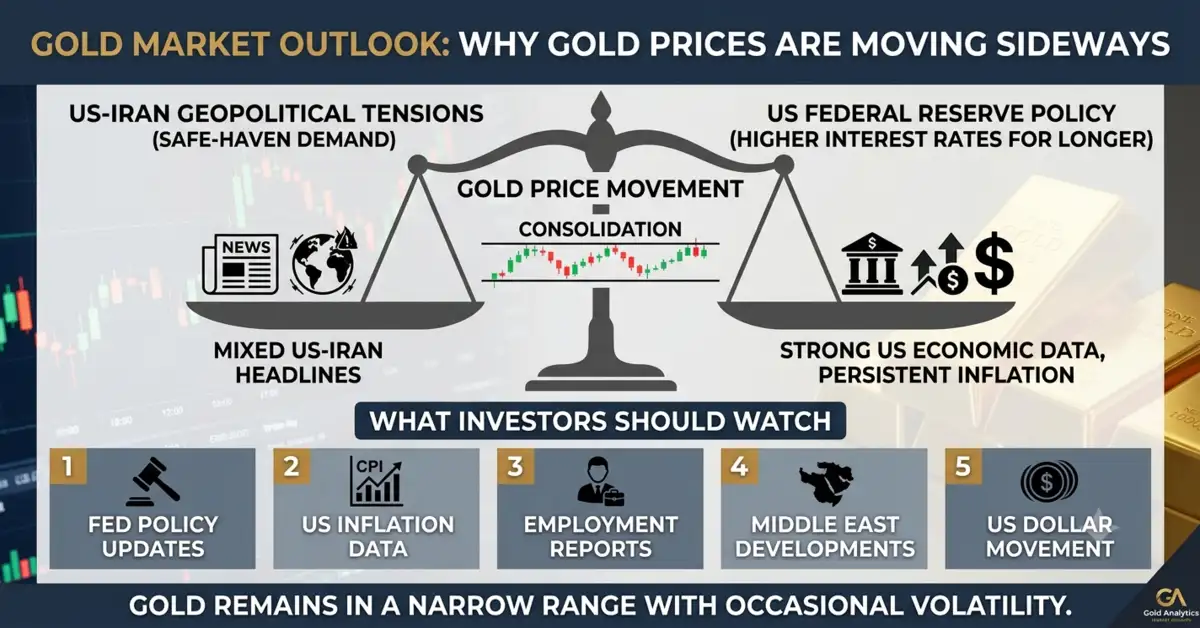
The overall outlook for gold remains balanced. While geopolitical uncertainty continues to provide support, expectations of higher US interest rates are limiting strong upward movement.
Investors may continue to adopt a wait-and-watch approach until there is more clarity on Federal Reserve policy and international developments. Until then, gold prices are expected to remain within a narrow range with occasional volatility.
Conclusion
Gold continues to consolidate as investors weigh mixed geopolitical news and the possibility of prolonged higher interest rates in the United States. Although safe-haven demand is still present, the stronger US Dollar and hawkish Federal Reserve expectations are preventing a major rally. Market participants will closely follow upcoming economic data and geopolitical events for the next direction in gold prices.
Frequently Asked Questions (FAQs)
1. Why is gold consolidating instead of rising?
Gold is trading sideways because safe-haven demand from geopolitical tensions is being balanced by expectations of higher US interest rates.
2. How does the Federal Reserve affect gold prices?
Higher interest rates usually make gold less attractive since it does not generate interest income, which can limit price gains.
3. Why do US-Iran tensions influence gold?
Gold is considered a safe-haven asset. Rising geopolitical tensions often increase investor demand for gold as a protective investment.
4. What factors should investors monitor for gold prices?
Investors should watch Federal Reserve decisions, inflation data, US economic reports, geopolitical developments, and the strength of the US Dollar.
5. Is gold still a good long-term investment?
Many investors continue to view gold as a long-term hedge against inflation, economic uncertainty, and global geopolitical risks, although prices can fluctuate in the short term.
Disclaimer
This article is intended for educational purposes only. The views and opinions expressed are those of individual analysts or brokerage firms and do not represent the views of GoldSilverReports.com. Investors are strongly advised to consult certified SEBI-registered financial experts before making any investment or trading decisions.