
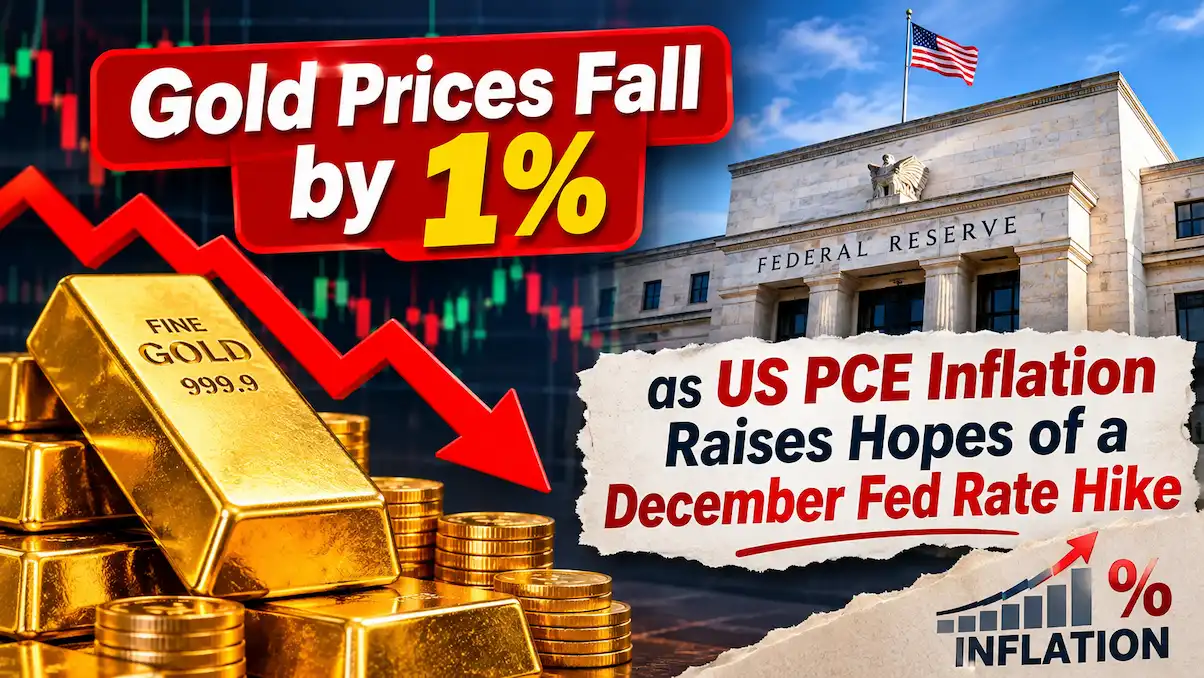
Gold Prices Today: Gold (XAU/USD) extends its intraday decline on Thursday as the latest US Personal Consumption Expenditures (PCE) inflation data reinforce expectations of a Federal Reserve (Fed) rate hike in December after the US central bank held interest rates steady at its October meeting. At the time of writing, XAU/USD trades around $4,022, down 1.11% on the day.
- Gold loses ground as the Fed’s hawkish stance weighs on the non-yielding metal.
- US PCE inflation matches forecasts, while GDP growth beats expectations.
- RSI and MACD signal weak momentum on the daily chart, while XAU/USD hovers above the lower Bollinger Band.
- Gold Holds Key Support Ahead of Fed Rate Decision
- Fed Rate Decision October 2026: Hike or Hold?
- Gold Midterm Forecast: Key Support and Resistance Levels
The headline PCE Price Index rose 0.5% MoM in September, matching expectations and accelerating from August’s 0.3% increase. Annual inflation climbed to 3.6% from 3.4%, also in line with forecasts.
The core PCE Price Index, which excludes food and energy, increased 0.3% MoM, matching expectations and August’s reading, which was revised up from 0.2%. On an annual basis, core inflation rose to 3.1% from 3.0%, as expected.
Federal Open Market Committee (FOMC)
The Federal Open Market Committee (FOMC) voted 10-2 on Wednesday to hold rates at 3.75%-4.00%. Governor Lisa Cook and Cleveland Fed President Beth Hammack favoured a 25-basis-point (bps) increase. While the pause was widely expected, the Fed’s patient approach in its fight against inflation despite mounting price pressures drew a mildly dovish initial reaction, lifting Gold while pushing the US Dollar and shorter-dated Treasury yields lower.
Still, the overall message remained hawkish. Chair Kevin Warsh reiterated his commitment to delivering price stability, noting that “while overall financial conditions are tighter, I’m unwilling and unable to call them tight.” Warsh also stressed that tackling inflation was not about a particular date or a single economic release.
Analysts at Rabobank highlight that, despite leaving policy unchanged, the Committee “indicated a need for more information to help determine the appropriate policy stance.” Chair Warsh underscored that the “FOMC will receive a lot more data in the weeks through the next meeting,” reinforcing the data-dependent nature of the Fed’s reaction function.
Rabobank’s US strategist concludes that, “without providing forward guidance, Warsh essentially made the case for a rate hike in December,” suggesting that the door to further tightening remains firmly open.
Inflation
The latest PCE data show inflation remains above the Fed’s 2% target, partly reflecting higher energy costs linked to Middle East tensions. Meanwhile, the preliminary estimate of third-quarter Gross Domestic Product (GDP) showed the US economy grew at an annualised rate of 3.4%, above expectations of 3.2% and up from 2.2% in the previous quarter.
Sticky inflation and stronger growth reinforce expectations of a December rate hike, with the CME FedWatch Tool showing an 83% chance of an increase. Those bets support the US Dollar and weigh on Gold, as higher interest rates increase the opportunity cost of holding the non-yielding metal.
The US Dollar Index (DXY), which tracks the Greenback’s value against a basket of six major currencies, reverses the previous day’s decline and trades around 102.30. A firmer Dollar adds pressure on Gold by making bullion more expensive for buyers using other currencies.
Key Details at a Glance
| Factor | What It Means for Gold |
|---|---|
| Gold price movement | Gold fell around 1%, according to the headline |
| US PCE inflation | A key indicator watched by the Federal Reserve |
| December Fed outlook | A possible rate hike has gained attention |
| Higher interest rates | Can reduce gold’s relative appeal |
| Stronger US dollar | Can put additional pressure on dollar-priced gold |
| Indian gold prices | Also depend on the rupee, import costs and local demand |
| Market outlook | Depends on upcoming economic data and Fed policy signals |
Technical Analysis
On the daily chart, XAU/USD remains below the 20-day Simple Moving Average (SMA) at $4,112, which forms the middle Bollinger Band, keeping the near-term bias bearish. The Relative Strength Index (RSI) hovers around 38, pointing to weak buying momentum without reaching oversold territory. Meanwhile, the Moving Average Convergence Divergence (MACD) remains slightly negative, suggesting that sellers retain control.
On the upside, initial resistance stands at the 20-day SMA near $4,113, followed by the upper Bollinger Band at $4,230. A sustained move above these levels could open the door toward $4,400.
On the downside, the lower Bollinger Band near $3,995 and the previous support zone around $4,000-$3,950 are likely to keep further declines in check. However, a decisive break below this area could trigger a deeper decline.
Conclusion
Gold prices came under pressure as US PCE inflation strengthened expectations of a possible Federal Reserve rate hike in December. Higher interest rates and a stronger US dollar can create challenges for the precious metal, particularly when investors expect better returns from other assets.
However, the future direction of gold remains uncertain. Traders will continue to monitor inflation data, economic growth and signals from the Federal Reserve. In India, currency movements and local market conditions will also play an important role in determining gold prices.
Investors and jewellery buyers should avoid making decisions based on a single economic report and should consider their financial goals and risk tolerance.
Frequently Asked Questions (FAQs)
1. Why did gold prices fall by 1%?
Gold prices fell around 1% as US PCE inflation data strengthened expectations of a possible Federal Reserve rate hike in December. The prospect of higher interest rates can reduce demand for gold.
2. What is US PCE inflation?
The Personal Consumption Expenditures price index measures changes in the prices of goods and services purchased by households in the United States. The Federal Reserve uses it as an important measure of inflation.
3. How does a Fed rate hike affect gold prices?
Higher interest rates can put pressure on gold because it does not provide regular interest income. Higher bond yields and a stronger US dollar can also make gold less attractive to some investors.
4. Will gold prices fall further in the coming days?
Gold prices could face further pressure if inflation remains high and expectations of tighter monetary policy increase. However, weaker economic data, lower bond yields or safe-haven demand could support prices. Future movements are uncertain.
5. Will falling international gold prices reduce gold rates in India?
Not necessarily by the same percentage. Indian gold prices are affected by international prices, the rupee-dollar exchange rate, import duties, taxes and local market costs. A weaker rupee can partly offset a fall in international gold prices.
Disclaimer
This article is intended for educational purposes only. The views and opinions expressed are those of individual analysts or brokerage firms and do not represent the views of GoldSilverReports.com. Investors are strongly advised to consult certified SEBI-registered financial experts before making any investment or trading decisions.
| Follow us on |
| Telegram, Whatsapp , Facebook, Twitter, Instagram, YouTube, Google Business Profile and Truth Social. |