
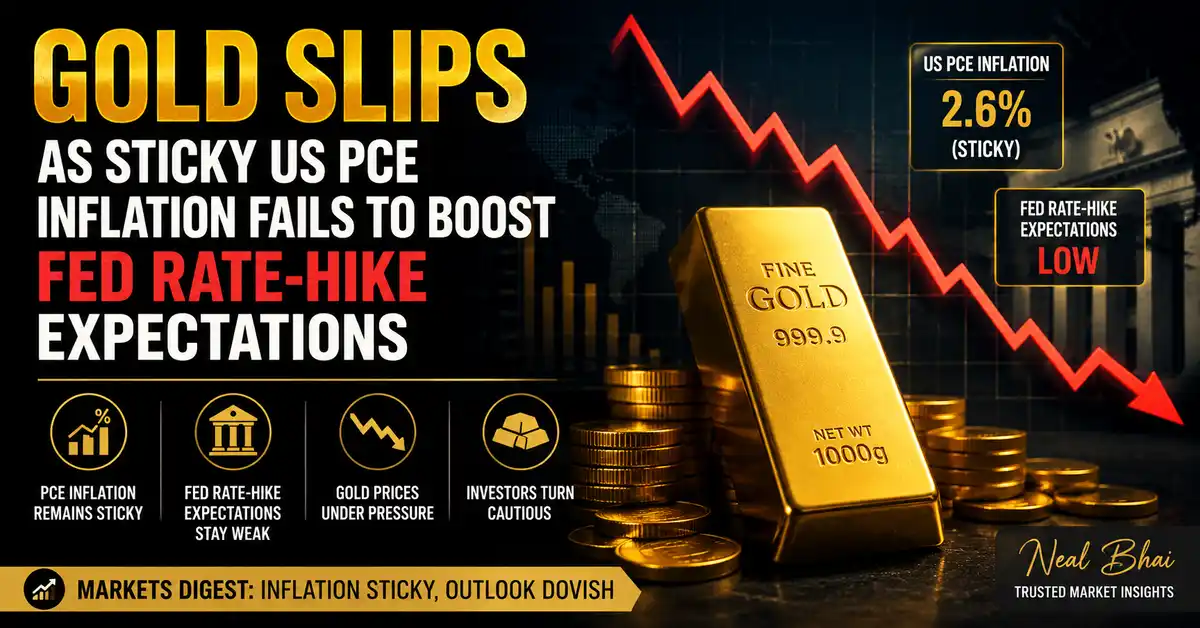
Gold (XAU/USD) trades around $4,620 on Wednesday at the time of writing, down 0.83% on the day. Bearish pressure on the precious metal strengthens modestly following the release of the Federal Reserve’s (Fed) preferred inflation gauge, although the data do little to alter market expectations for the central bank’s September meeting.
- Gold Price Target $5,200: What Did Neal Bhai Say?
- Silver Demand: Data Centres Could Drive Electronics Demand
- Gold Holds Firm as Fed Minutes and Iran Risks Keep Markets Cautious
- Silver Price Forecast: XAG/USD Eyes $66 as Dollar Weakens
The Bureau of Economic Analysis (BEA) reported that the Personal Consumption Expenditures (PCE) Price Index rose 3.7% YoY in July, unchanged from June but slightly above the 3.6% expected by markets. The core PCE Price Index, which excludes volatile food and energy prices, remained steady at 3.3% YoY in July, matching market expectations. On a monthly basis, the PCE Price Index and the core PCE Price Index both rose by 0.2%.
The slightly stronger-than-expected headline reading initially added some downward pressure on Gold, as persistent inflation could support the case for keeping US interest rates elevated. However, the report does not appear strong enough to significantly reshape expectations for Federal Reserve monetary policy.
Interest-rate hike
Markets continue to price in around a 36% chance of an interest-rate hike at the Fed’s September meeting, leaving roughly a 64% chance that borrowing costs will remain unchanged. These probabilities are broadly similar to those seen before the PCE release.
The limited reaction in rate expectations suggests that investors view the report as broadly consistent with the existing monetary policy outlook. While headline PCE inflation proves slightly more persistent than anticipated, the core measure, which is closely monitored for underlying inflation trends, comes exactly in line with expectations.
Minister Kazem Gharibabadi said
Geopolitical developments also remain in focus. Iranian Deputy Foreign Minister Kazem Gharibabadi said that the temporary transit agreement with Oman does not mean that the Strait of Hormuz has reopened, adding that the waterway will remain closed until the United States (US) fulfills its commitments under the Memorandum of Understanding (MoU).
Market attention will now turn to Fed Chair Kevin Warsh’s speech at the Jackson Hole Economic Policy Symposium on Friday. The event could prove particularly significant for financial markets, as investors will closely scrutinize Warsh’s comments for fresh signals on the Fed’s policy outlook ahead of the September meeting. Any indication that the central bank is leaning toward keeping rates unchanged or considering another hike could trigger volatility in the US Dollar, US Treasury yields and, consequently, Gold.
XAU/USD Technical Analysis
In the one-hour chart, XAU/USD trades at $4,620.38, holding a constructive short-term bias as it remains above both the 100-period simple moving average (SMA) at $4,606.20 and the 200-period SMA at $4,502.80. This positioning suggests that dips are still being supported by the broader uptrend, even as prices recently broke its ascending trendline. The Relative Strength Index (RSI) near 41.00 hints at waning upside momentum, indicating that bulls may need fresh impetus to challenge overhead barriers decisively.
On the downside, initial support is seen at the horizontal level of $4,607.18, closely backed by the 100-period SMA at $4,606.20, while deeper demand is expected near the 200-period SMA at $4,502.80. On the topside, immediate resistance is located around the horizontal resistance of $4,697.00; a sustained break above these levels would open the way for a stronger bullish continuation in the near term.
Gold Market Summary Table
| Factor | Current Market Impact | Possible Effect on Gold |
|---|---|---|
| US PCE Inflation | Inflation remains sticky | Can create pressure |
| Fed Rate-Hike Expectations | Limited increase | Potentially supportive |
| US Dollar | Key market driver | Strong dollar can weigh on gold |
| Treasury Yields | Closely watched | Higher yields may pressure gold |
| Fed Policy | Data dependent | Can increase volatility |
| Investor Sentiment | Cautious | May create two-way movement |
| Safe-Haven Demand | Important support factor | Can support gold prices |
Fed Rate-Hike Expectations Remain Limited
Despite persistent inflation pressure, the latest data has not created a major increase in expectations for another Fed rate hike.
This is important for gold because a sharp rise in rate-hike expectations could put additional pressure on the precious metal. Instead, traders remain focused on the possibility that the Federal Reserve could maintain its current policy stance while waiting for clearer evidence from upcoming economic data.
The US dollar and Treasury yields could remain key drivers for gold in the near term.
Frequently Asked Questions (FAQs)
Why did gold prices slip?
Gold prices slipped as traders assessed sticky US PCE inflation and its possible impact on Federal Reserve monetary policy.
What is US PCE inflation?
The Personal Consumption Expenditures (PCE) price index is an important US inflation measure closely watched by the Federal Reserve when assessing price pressures.
Does high inflation always hurt gold?
Not always. High inflation can pressure gold if it increases expectations of higher interest rates. However, gold can also benefit from inflation concerns and safe-haven demand depending on market conditions.
How do Fed rate hikes affect gold?
Higher interest rates can make interest-bearing assets more attractive and may strengthen the US dollar, which can put pressure on gold. Lower-rate expectations can have the opposite effect.
What should gold traders watch next?
Traders should monitor upcoming US inflation and employment data, Federal Reserve comments, Treasury yields and US dollar movements for clues about the next major gold move.
Disclaimer
This article is intended for educational purposes only. The views and opinions expressed are those of individual analysts or brokerage firms and do not represent the views of GoldSilverReports.com. Investors are strongly advised to consult certified SEBI-registered financial experts before making any investment or trading decisions.